
Healthcare Must-Haves

Band-Aids are just the beginning.

Even in normal times, when the COVID pandemic isn’t surging through the world, your list of medicine cabinets must-haves remain pretty much the same. Bandages, gauze pads and hydrogen peroxide, which are available everywhere, are essentials for accidental cuts. But there are more must-haves you’ll need before you head for Urgent Care. I’ve skipped rapid COVID tests, as they may give false readings. The gold-standard is the uncomfortable nose swab test. Some clinics administer the saliva test, which these days takes about five days before you get a result.

Band-Aids are just the beginning

Even in normal times, when the COVID pandemic isn’t surging through the world, your list of medicine cabinets must-haves remains pretty much the same.

Bandages, gauze pads and hydrogen peroxide, which are available everywhere, are essentials for accidental cuts. But there are more must-haves you’ll need before you head for Urgent Care. I’ve skipped rapid COVID tests, as some may give false readings. The gold-standard is the uncomfortable nose swab test. Some clinics administer the saliva test, which these days takes about five days before you get a result.

A no-touch forehead thermometer is No. 1 for your entire family. There are dozens available on Amazon. After reading the reviews, I bought the $20 iHealth model. Like other no-touch thermometers, it will vary by about one-half degree on successive readings. I take three readings and average them. There are more expensive models, but the iHealth seems to work just fine.

An oximeter, which measures blood oxygen saturation, costs about $20 on Amazon. The device has a clothespin-like feature; slip it on a finger and it will give you an oxygen-saturated reading and your pulse rate. Your doctor can tell you what your readings should be. I bought the Santimedical model, which uses two AAA batteries (included) that seem to last forever.

Blood pressure monitors come with a caveat. No matter what model you choose, they need to be calibrated with a doctor’s office machine. Steer clear of wrist monitors. The best ones have a cuff that wraps around your bicep. I like the Omron models that range upwards of $50. Cheaper ones may not give an accurate reading, and even the Omron model I bought on Amazon was off by about 10 points when compared to a professional monitor. Still, if the home monitor seems high, it’s worth a visit to your doctor’s office.

Heart monitors can be helpful, too. The Kardia devices (which I review in full here) cost from $70 to $180 on Amazon or at www.kardia.com. The least-expensive models measure whether your have atrial fibrillation, a common but potentially serious heart condition, along with pulse rate. They’re easy to use, too. Rest your index fingers on two metal pads and get the reading on your smartphone.

Paying attention to temperature, heart function and blood pressure will ultimately help you decide whether to make that trip to Urgent Care or even the ER. The tools you use to make that decision are inexpensive and widely available, too.

Pros

  • Must-haves in your medicine cabinet should include a few high-tech devices.

Cons

  • You may need more space to store your essential health tools.

Summary
Low-cost medical gear can save you a trip to the doctor.
Put Your Kardia on the Table

Tiny device tells you if you have a heart ailment

Erratic or racing heartbeat can mean trouble. If they’re accompanied by chest pain, a trip to the ER is a wise decision. The first thing you’ll get at the ER is an electrocardiogram, which will give the ER doctor an idea of the seriousness of your visit. But what if you could get the electrocardiogram at home and send it to your doctor or another cardiologist.  And what if you could carry the device around in your pocket?

Erratic or racing heartbeat can mean trouble. If they’re accompanied by chest pain, a trip to the ER is a wise decision.

The first thing you’ll get at the ER is an electrocardiogram, which will give the ER doctor an idea of the seriousness of your visit. But what if you could get the electrocardiogram at home and send it to your doctor or another cardiologist.  And what if you could carry the device around in your pocket?

The Kardia Mobile will do just that, and more. While the basic $79 model will measure only possible atrial fibrillation (irregular heartbeat and pulse), more sophisticated (and expensive) ones will do far more. The $150 6L model emulates a six-lead EKG, similar to the one you’d have in a doctor’s office. It also measures whether your heart is beating too fast or too slowly. For $10 a month you can get reviews by a cardiologist, among other benefits. For $150 you can get a credit card model that has the same limits as the $79 model.

The heart likes a steady rhythm. When it’s out of whack, you feel it in the form of palpitations, rapid heartbeat and, oftentimes, exhaustion. If you have sleep apnea (loud snoring and gasping for air at night) or you’re obese, your chances of developing a-fib are pretty good.

The  Kardia Mobile is about the size of a Band-Aid. On the top are two pads that record the EKG. Fingers from both hands are placed on the pads, and like a real EKG, the peaks and valleys of your heartbeats flash by on the screen of your smartphone. In 30 seconds, there’s a diagnosis: “normal,” “possible atrial fibrillation,” “unclassified” or “unreadable.” Therein is the flaw in the KardiaMobile.

While the “normal” reading is reassuring and the “possible atrial fibrillation” is cause for concern, the device will not tell you whether you’re having a heart attack. Unless you know how to read an EKG, you would have to upload the EKG to your doctor or to an EKG technician that Kardia hires ($9) or to one of Kardia’s contract cardiologists ($19). In the latter, a doctor will respond within an hour;  the cheaper fee  gets you a technician’s diagnosis in 24 hours, which is way too long if your heart is in distress.

Other factors can be troublesome. The Kardia Mobile won’t deliver an EKG if there is any kind of electrical interference such as a nearby computer and monitor. Moving 20 feet away, solves the problem.

I found out about the Kardia Mobile when my cardiologist’s EKG machine was tied up. For good measure, though, he asked me to wait and get a proper EKG, which, as the Kardia device concluded, was normal.

The device does its work in 30 seconds and works on iPhones, Android phones and tablets. The company also offers a $10 monthly “premium” plan that allows users to store their EKGs, get monthly reports that can be e-mailed to yourself or to your doctor and provide reminders to take medications. In the basic plan, which is free, users can e-mail only one EKG at a time to their doctor or to themselves. If you do the latter, there’s nothing to stop you from printing out yourf EKG and hanging it on the refrigerator for all to admire. In the basic plan, prior tests can’t be saved for comparison. (For other medicine cabinet essentials, click here.)

If you have a history of a-fib, and you want the assurance that it’s being controlled by medication or other treatments, the Kardia Mobile will provide an inexpensive and convenient EKG. But it does not take the place of a proper EKG or other heart study. In fact, in the space of 30 minutes, under exactly the same conditions, I had two “unclassified” readings, two were “normal” and one showed “possible atrial fibrillation.” That’s not exactly reassuring.

Pros

  • 30-second EKG
  • $79 modell ismall enough to carry in a shirt pocket
  • Inexpensive

Cons

  • Won’t tell if you’re having a heart attack
  • Basic model is limited to normal heart rhythm or possible a-fib
  • Models that have more functions are pricey

Summary
If you need a quick and basic EKG, the $80 Kardia Mobile is limited reading normal heartbeats and afib. A more expensive model will diagnose more heart functions.

The devices are sold on Amazon and at www.kardiamobile.com.

Recommendation
The $150 Kardia 6L is worth the extra price, because it measures multiple heart fuctions.

epic-ID is the Only Medical Wristband You’ll Ever Need

This ID could save your life

If I took a nasty spill on my morning walk, and suffered broken bones or head injuries, what would first responders need to know right away?

This ID could save your life

If I took a nasty spill on my morning walk, and suffered broken bones or head injuries, what would first responders need to know right away?

Don’t leave home without it.

For starters, they’d need to know my name, blood type, whether I have any major medical conditions.  They’d want to have several emergency contacts, if there were no answer for the first contact. Then there are issues that they’d need to know after I was stabilized: medical plan, primary physician and preferred hospital.

I never much thought about taking that serious spill until a few weeks ago. When it happened, I was more confused and embarrassed than injured. A passerby offered to call for help, but I got up, dusted myself off and went on my way.

Awhile before my spill, I noticed that a friend was wearing a black wrist band called on epic-ID. She explained that the band had all her pertinent medical information stored on a USB flash drive that connects to a Windows PC or Mac. The friend , a doctor, urged me to get one.

Two weeks after my fall, I finally stopped being in denial and ordered one, which I now wear on my right wrist when I go out walking or driving.

Here’s how it works.

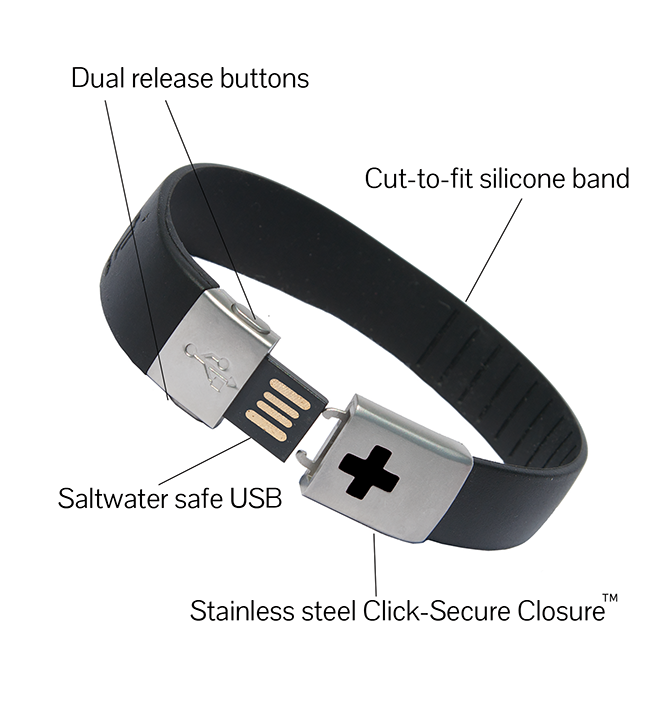
The epic-ID has an adjustable, hypoallergenic silicone wrist band that has a USB connection that can be read by any computer – Mac or Windows. (First responders are trained to look for medical wrist bands.) The USB end of the band connects to computers that first-responders carry on their vehicles. The other end of the waterproof wrist band can by trimmed down to fit your wrist.

Your personal Information is stored on a tiny flash drive on the wrist band itself. It has no battery. There are no monthly fees. It doesn’t  connect to the Internet, so your information is safe from identity theft. The only thing you have to worry about is losing the band, and you can guard against that by wearing it all the time – it’s waterproof, too. 

Once the USB end of the wrist band is connected to a Windows or Mac computer, there are three sections that pop up immediately.

Personal Information prompts you to type in your name, date of birth, address, blood type and emergency contacts. There’s also a place to import your photo.

From there, you go to the Medical Information tab, where you describe  your allergies and whether you’re up-to-date on your flu shot and other immunizations.

Current prescriptions are next, followed by information on prior surgeries and hospitalizations. A family medical history is next.

The third and last form deals with information about your doctor(s), medical group, membership number and extent of your medical coverage. Information can be updated at any time just by plugging the USB end of the wrist band into a PC.

The wrist band also comes with a metal tag that has room for five lines of information (name, emergency contact, medical problems, for example). The plate fits right on the wrist band. opposite the USB connection, which is securely made. The wrist band itself comes in three colors – black, white and red. epic-ID sells a package of 18 wrist bands for $300. A single one costs $50, with the metal plate.

For more information: visit http://www.epic-id.com or call (844-437-4243).